
ChatGPT Ads: Our Early Results, Costs, and What Marketers Should Know
We tested ChatGPT Ads. Here is what we learned about CPCs, audience reach, targeting, product feeds, and whether the platform is worth your budget today.

When OpenAI launched ChatGPT Ads, we were keen to test them.
At LLM Listed, we spend our days helping companies improve their visibility in AI search results across ChatGPT, Gemini, Claude, and Perplexity. Naturally, when ChatGPT opened up advertising opportunities, we wanted to see how the platform worked, what the costs looked like, and whether it could become a meaningful acquisition channel for B2B businesses.
It's still very early days, but we've already learned a few things worth sharing.
ChatGPT Ads Are Still Rolling Out
At the time of writing, ChatGPT Ads are available to selected advertisers, with access currently focused on US accounts.
OpenAI appears to be gradually expanding availability, with broader access expected in markets such as the UK and Australia in the near future.
That rollout strategy makes sense. Search advertising platforms are notoriously difficult to scale. OpenAI needs to balance advertiser demand with user experience while ensuring ad quality remains high.
For marketers, this means there is still an opportunity to be an early mover before competition increases.
The Platform Is Surprisingly Familiar
One thing that stood out immediately is how familiar the advertising interface feels.
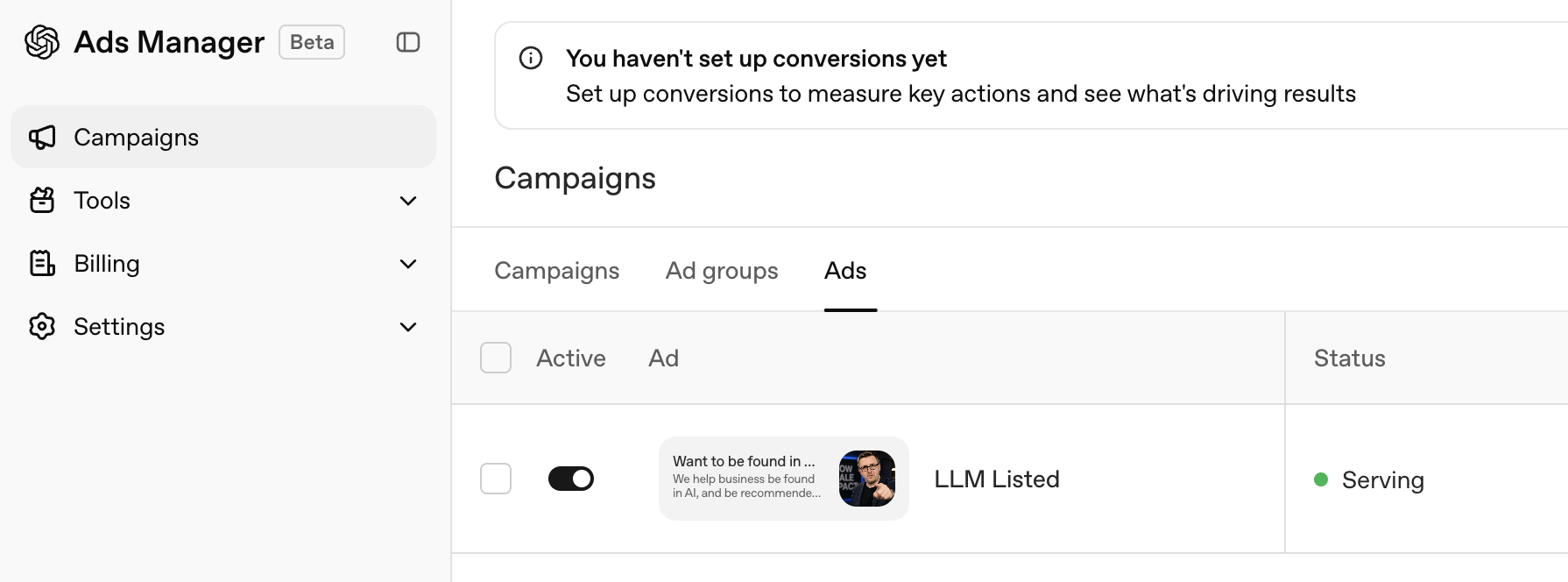
The campaign creation workflow follows a structure that most digital marketers will recognize:
- Create a campaign
- Choose an objective
- Set locations
- Define budgets
- Build ad groups
- Launch ads
Current objectives are relatively simple, focusing primarily on traffic generation and clicks.
The campaign setup screen includes location targeting, budget controls, campaign naming, and conversion settings. The experience feels closer to a lightweight search advertising platform than a social media advertising platform.
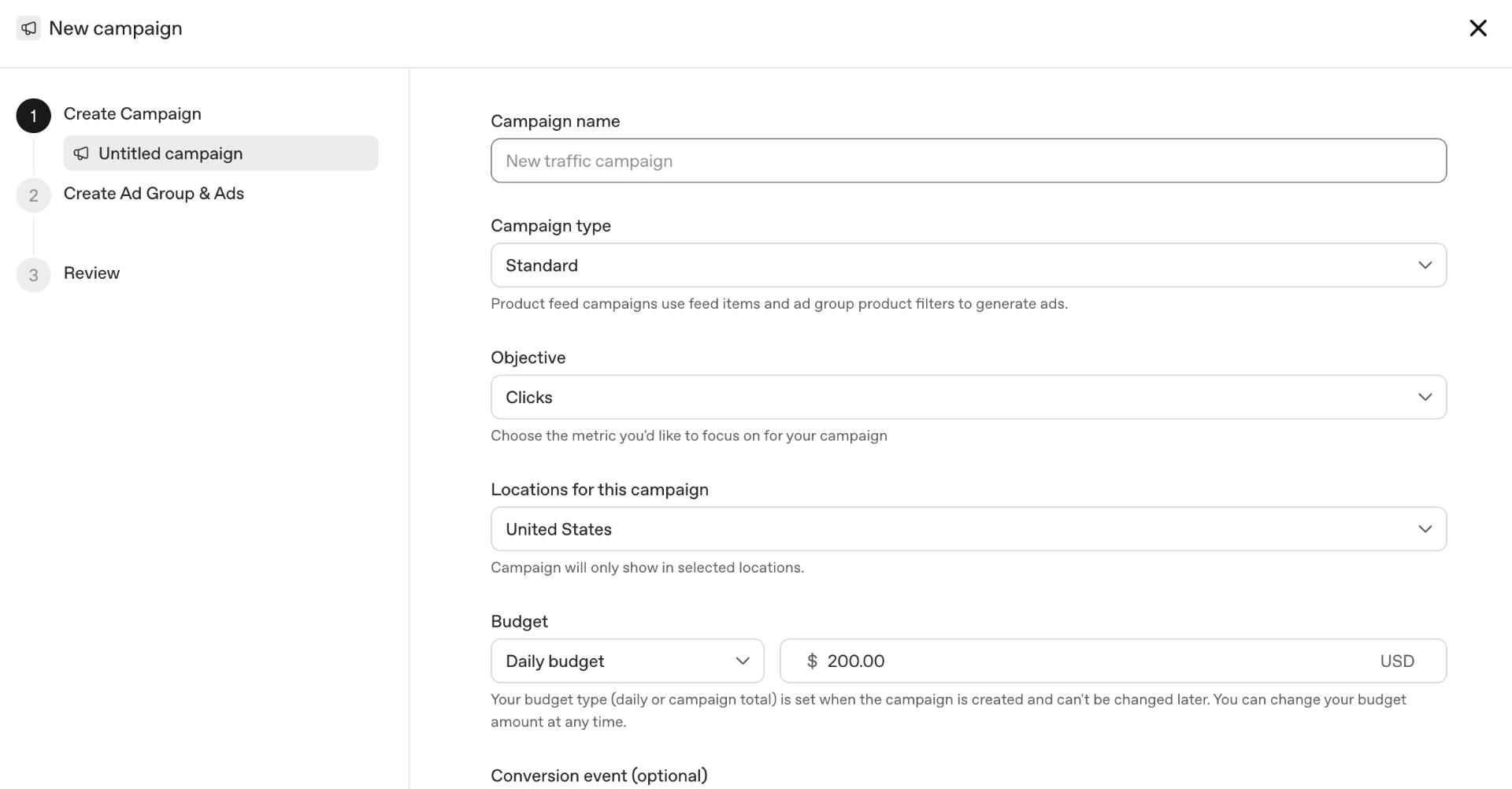
For anyone with experience running Google Ads or Microsoft Ads campaigns, the learning curve is minimal.
Product Feed Support Already Exists
One interesting feature is the inclusion of product feed functionality.
The platform allows advertisers to upload product feeds via SFTP, enabling product-based campaigns and inventory-driven advertising.
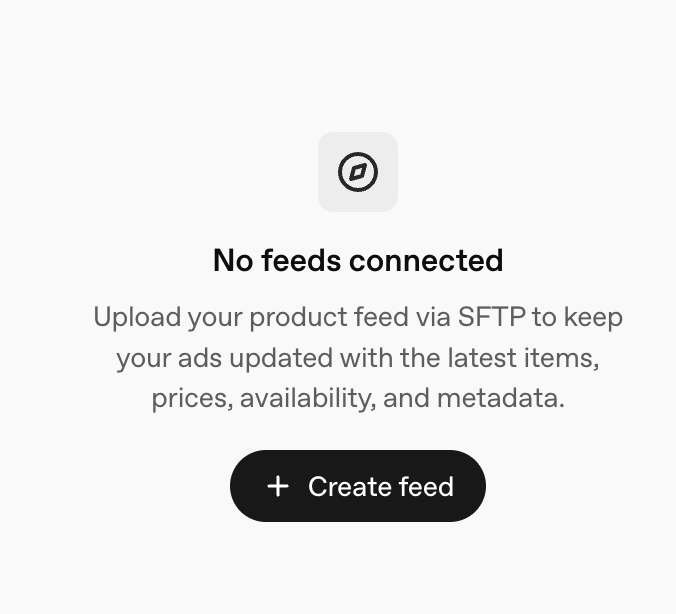
This suggests OpenAI is already thinking beyond simple text ads and preparing infrastructure for ecommerce and catalog-based advertising.
While many businesses will initially focus on lead generation and traffic campaigns, product feeds indicate a much broader long-term vision.
If OpenAI eventually integrates shopping experiences directly into ChatGPT conversations, advertisers who already have feed infrastructure in place could gain an advantage.
Ad Approval Has Been Slow
One of the biggest challenges we've encountered so far has been ad approval times.
Compared with mature advertising platforms, approval appears noticeably slower.
That is not necessarily surprising. OpenAI is still developing policies, moderation workflows, and quality controls. Every new advertising platform goes through this phase.
However, marketers should plan accordingly.
If you're launching a campaign around a specific event, webinar, product release, or promotion, leave significantly more time than you would typically allow for Google Ads or LinkedIn Ads.
The approval process is improving, but it is not yet operating at the speed most advertisers are used to.
Our Early Cost Per Click Results
The question most marketers ask first is simple:
"How much does a click cost?"
Across our initial campaigns, we're currently seeing an average cost per click of approximately $3.42.
For context, that places ChatGPT somewhere between many B2B social campaigns and higher-intent search campaigns.
Whether that represents good value depends entirely on lead quality and conversion rates, which we are still evaluating.
At this stage, we would not focus solely on CPC.
The more important question is whether ChatGPT users demonstrate stronger buying intent than users coming from traditional advertising channels.
That's where things become interesting, and where the platform's current limitations start to matter.
The Biggest Limitation Right Now: Audience Reach
The most important thing advertisers need to understand is that ChatGPT Ads currently do not reach every ChatGPT user.
At present, ads are shown only to users on the Free plan and the Go plan, which costs around $8 per month in supported markets.
That means the audience excludes a significant portion of power users who subscribe to higher-tier plans.
For B2B advertisers, this creates an interesting challenge.
Many of the people most actively using AI for business research, software evaluations, procurement decisions, and professional workflows are also the people most likely to pay for premium AI subscriptions.
In other words, some of the highest-value buyers may not currently see your ads.
That does not mean the platform lacks potential. Far from it.
The free user base is enormous, and many business owners, marketers, consultants, and decision makers still use the free version regularly. However, advertisers should understand that today's inventory does not yet represent the entire ChatGPT audience.
As OpenAI expands advertising availability, this could become one of the most significant changes to campaign performance.
Targeting Is Currently Quite Basic
Another area where the platform is clearly still evolving is targeting.
Today, advertisers provide what OpenAI calls "Context Hints."
These are essentially descriptions of topics, conversations, keywords, and areas where your product may be relevant.
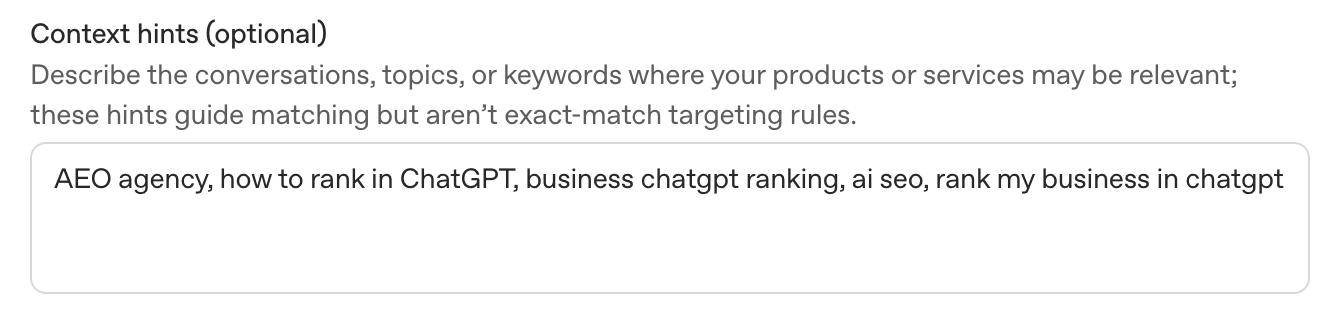
For example, one of our campaigns includes hints such as:
- AEO agency
- How to rank in ChatGPT
- Business ChatGPT ranking
- AI SEO
- Rank my business in ChatGPT
The platform specifically notes that these are not exact-match targeting rules.
Instead, they help OpenAI understand the types of conversations where your ads may be relevant.
This is very different from Google Ads, where advertisers can target exact keywords, phrase match terms, audiences, demographics, and extensive behavioral signals.
At this stage, targeting feels more like providing guidance to the model than configuring a traditional advertising campaign.
That may sound limiting, but it is also one of the more interesting aspects of the platform. OpenAI is effectively using semantic understanding rather than rigid keyword matching to determine ad relevance.
The question is whether that ultimately produces better outcomes than traditional search advertising.
What We Like So Far
Despite the platform's early-stage limitations, several things stand out positively.
First, the user experience is clean and straightforward. Campaign creation takes minutes rather than hours.
Second, the ad environment feels far less crowded than traditional search engines. On Google, users are accustomed to seeing multiple advertisers competing for attention. On ChatGPT, advertising still feels new and therefore potentially commands more attention.
Third, users often arrive in ChatGPT with highly specific questions and intent.
Someone asking:
- "What is the best AI visibility agency?"
- "How do I improve my rankings in ChatGPT?"
- "What is Answer Engine Optimization?"
is already demonstrating significant interest in a topic.
That level of intent is one reason we're optimistic about the platform's long-term potential.
What We Don't Like So Far
There are still some challenges.
- The approval process needs to speed up.
- Reporting remains relatively limited compared to mature advertising platforms.
- Targeting controls are basic.
- Conversion tracking is still developing.
- And perhaps most importantly, the current audience restrictions limit reach for many B2B advertisers.
These are all understandable given how new the platform is, but they are worth considering before committing substantial budget.
Is ChatGPT Advertising Worth Testing?
Our answer today is yes, but with realistic expectations.
We would not recommend shifting large portions of an existing Google Ads budget into ChatGPT Ads today.
However, if you are already spending on paid acquisition and want to understand where AI-driven advertising is heading, this is absolutely worth testing.
The platform gives advertisers an early opportunity to learn how AI-native advertising works before competition increases.
That alone has value.
The companies that learn these systems early will likely have an advantage as OpenAI expands inventory, targeting options, reporting capabilities, and conversion tracking.
Frequently Asked Questions
How much do ChatGPT Ads cost?
In our early campaigns, we have seen average cost per click rates around $3.42. Results will vary depending on industry, targeting, competition, and campaign quality.
Can anyone advertise on ChatGPT?
OpenAI is gradually rolling out access. At the time of writing, availability is primarily focused on US-based accounts, with expansion expected into additional markets.
Are ChatGPT Ads good for B2B companies?
Potentially yes, but there are limitations. Since ads currently appear only to Free and Go users, some professional users on higher-tier plans may not see them.
Can you target specific keywords?
Not in the traditional Google Ads sense. Advertisers currently provide context hints and topic guidance rather than exact-match keywords.
Does ChatGPT support ecommerce advertising?
Yes. The platform already includes support for product feeds, suggesting broader ecommerce functionality is planned or already being tested.
Should I move budget from Google Ads to ChatGPT Ads?
Not yet. For most businesses, ChatGPT Ads should currently be treated as an experimental channel rather than a replacement for established paid acquisition platforms.
The Bigger Opportunity Isn't Ads
Interestingly, our biggest takeaway from testing ChatGPT Ads isn't about advertising at all.
It's a reminder that visibility inside AI platforms is becoming increasingly important.
Most businesses currently focus on paid visibility and traditional SEO. Far fewer understand how often ChatGPT, Gemini, Claude, and Perplexity are already recommending businesses, products, services, and content.
Whether users click an ad or receive an organic recommendation from an AI model, the result is the same: visibility creates opportunities.
If you're not sure how visible your business is across AI platforms today, we can help.
Get a Free AI Visibility Scan
At LLM Listed, we analyze how your company appears across ChatGPT, Gemini, Claude, and Perplexity.
Our free visibility scan shows:
- Whether AI platforms mention your business
- How often competitors appear instead
- Which prompts trigger recommendations
- Citation and authority gaps
- Opportunities to improve AI visibility
If you want to understand how discoverable your business is in the age of AI search, request a free visibility scan and see where you stand today.